

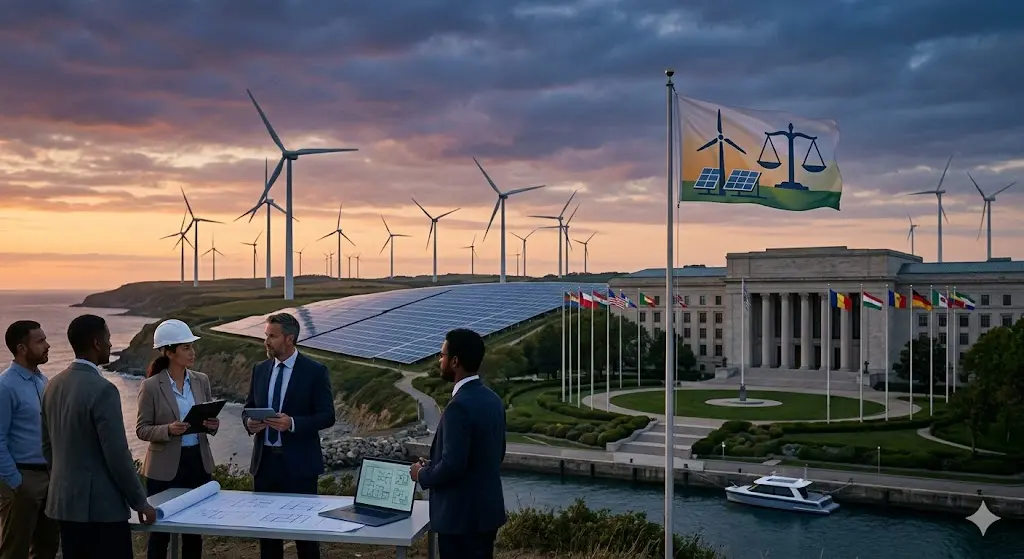
Renewable infrastructure is changing international legal systems because countries can no longer treat energy policy as a local issue. Solar grids, offshore wind farms, battery storage networks, and cross-border clean energy investments are forcing governments to rewrite trade agreements, environmental laws, tax systems, and corporate regulations at the same time.
What’s happening now goes far beyond climate discussions. Renewable energy infrastructure is reshaping how nations cooperate, compete, and settle disputes. And honestly, most people still underestimate how fast these legal shifts are happening.
Renewable infrastructure is changing international legal systems by creating new rules around energy trade, carbon emissions, investment protection, land rights, environmental compliance, and global climate cooperation. Governments now need legal frameworks that support cross-border renewable projects, protect investors, and regulate emerging clean-energy markets.
What Is Renewable Infrastructure?
Renewable Infrastructure: Physical systems and facilities designed to generate, store, or distribute energy from renewable sources such as solar, wind, hydro, geothermal, and green hydrogen.
That includes more than solar panels and wind turbines. It also covers electric vehicle charging networks, smart grids, battery storage systems, international power cables, and clean-energy transport corridors.
Here’s the thing most people overlook: infrastructure changes laws faster than political speeches do.
Once countries invest billions into renewable systems, legal reform becomes unavoidable. Governments suddenly need updated regulations for foreign investment, land acquisition, labor rights, environmental standards, and international energy trade.
You can already see this shift across Europe, Asia, Africa, and North America. Nations are rewriting energy agreements because the old fossil-fuel legal structures simply don’t fit renewable economies anymore.
Why Renewable Infrastructure Matters in 2026
By 2026, renewable infrastructure is no longer a side project. It’s becoming central to economic strategy and geopolitical influence.
Countries want energy independence. Businesses want predictable energy costs. Investors want long-term stability. Clean-energy infrastructure sits right in the middle of all three goals.
That pressure is transforming international legal systems in several ways.
Cross-Border Energy Agreements Are Expanding
A decade ago, oil pipelines dominated international energy law discussions. Now governments are negotiating renewable electricity exchanges, offshore wind cooperation zones, and hydrogen export agreements.
For example, several European countries are building interconnected offshore wind systems in the North Sea. Those projects require shared legal frameworks covering taxation, marine boundaries, environmental protection, and energy pricing.
Without coordinated laws, the projects stall.
Climate Litigation Is Increasing
Companies and governments are facing more lawsuits related to emissions targets and renewable commitments. Courts in multiple countries are now treating climate obligations as enforceable legal responsibilities instead of optional policy promises.
That’s a massive shift.
In my experience, this is one of the biggest legal transformations happening quietly behind the scenes. Climate law used to feel symbolic in many jurisdictions. Now it affects investment decisions, corporate governance, and international trade negotiations directly.
Trade Law Is Being Rewritten
Renewable infrastructure depends heavily on international supply chains. Solar materials, battery minerals, and wind technology components move across borders constantly.
Because of that, trade law is evolving around:
Carbon tariffs
Green subsidies
Clean-energy manufacturing rules
Sustainable sourcing requirements
Environmental compliance certifications
What most guides miss is that renewable energy isn’t only changing environmental law. It’s reshaping commercial law too.
Energy Security Has Become a Legal Priority
Russia’s energy disputes with European nations exposed how vulnerable countries become when energy dependence concentrates in one region.
As a result, governments are legally prioritizing renewable infrastructure projects through accelerated permitting systems, tax incentives, and international investment protections.
That trend will probably intensify over the next few years.
How Renewable Infrastructure Changes International Legal Systems Step by Step
Understanding the process makes the bigger picture easier to follow.
1. Governments Invest in Renewable Projects
Countries begin funding large-scale solar, wind, hydro, or battery projects to reduce fossil-fuel dependence.
At first, the focus is mostly economic and environmental.
Then legal complications appear.
2. Foreign Investors Enter the Market
Large infrastructure projects attract international investors, energy corporations, and development banks.
Once foreign money enters the equation, governments need updated legal protections covering:
Investment security
Contract enforcement
Tax obligations
Environmental compliance
Arbitration procedures
International legal systems become more interconnected almost overnight.
3. Trade Rules Start Changing
Renewable infrastructure creates demand for imported technology and raw materials.
Countries begin negotiating new agreements related to:
Green manufacturing standards
Carbon border adjustments
Renewable energy exports
Sustainable mining practices
That process reshapes international trade law in real time.
4. Environmental Regulations Expand
Renewable projects still affect ecosystems, local communities, and land rights.
So governments introduce stricter rules involving:
Biodiversity protection
Indigenous land claims
Water use restrictions
Offshore development zones
Environmental impact assessments
Ironically, clean-energy projects sometimes trigger legal disputes themselves.
That surprises people.
5. International Courts and Arbitration Grow More Active
As renewable investments increase, disputes rise too.
Companies sue governments over canceled projects. Nations challenge subsidy policies. Communities contest land acquisitions.
International arbitration courts are becoming major players in renewable infrastructure conflicts.
And honestly, we’re probably still early in that cycle.
A Real-World Example of Legal Transformation
Consider a hypothetical but realistic offshore wind project involving three neighboring countries sharing a coastal region.
One country manufactures turbine components. Another hosts the offshore installation. The third purchases the electricity through a long-term import agreement.
Sounds straightforward, right?
Not really.
The project immediately raises legal questions involving:
Maritime boundaries
Energy pricing rules
Cross-border taxation
Labor standards
Environmental liability
Insurance requirements
Dispute resolution procedures
Without coordinated international legal systems, the entire project could collapse before construction even begins.
This is exactly why renewable infrastructure is pushing governments toward deeper legal cooperation.
Expert Tip: Watch Infrastructure Financing Laws Closely
If you want to understand where international legal systems are heading, pay attention to renewable infrastructure financing.
That’s where many legal battles now start.
Banks, investment funds, and multinational institutions increasingly require strict sustainability compliance before financing major projects. Governments that fail to meet those standards may struggle to attract international capital.
From what I’ve seen, financing rules are becoming just as influential as environmental regulations.
How Renewable Infrastructure Affects Developing Countries
Developing nations face a different kind of legal pressure.
Many countries in Africa, Southeast Asia, and Latin America are attracting foreign renewable investment rapidly. But their legal systems sometimes struggle to keep pace with complex international contracts.
That creates challenges involving:
Land ownership disputes
Resource rights
Regulatory transparency
Corruption concerns
Community compensation systems
Here’s a counterintuitive point: renewable energy can actually increase legal tensions in regions with weak governance structures.
People often assume clean energy automatically creates social stability. In reality, poorly regulated renewable expansion can trigger serious disputes over land, labor, and political control.
That doesn’t mean renewable infrastructure is harmful. It means legal modernization matters just as much as technological development.
H3: Common Mistake or Misconception
Renewable Energy Does Not Automatically Simplify International Law
A lot of people think renewable systems reduce global conflict because sunlight and wind are widely available.
That sounds logical. But international law is becoming more complicated in many respects.
Why?
Because renewable infrastructure depends on rare-earth minerals, advanced manufacturing, international financing, and massive cross-border data systems. Those factors introduce entirely new legal risks.
Battery supply chains alone are generating legal debates around mining ethics, labor protections, and export restrictions.
So while renewable energy may reduce fossil-fuel dependency, it also creates fresh areas of international legal negotiation.
Expert Tips: What Actually Works
Countries handling renewable legal reform successfully tend to follow a few practical strategies.
They Standardize Regulations Early
Governments that establish clear renewable permitting systems attract more stable investment.
Unclear regulations scare investors away fast.
They Coordinate Internationally
Cross-border renewable infrastructure only works when countries align legal standards.
Shared energy systems need shared legal expectations.
They Protect Local Communities
Projects move faster when governments include local populations early instead of treating communities as obstacles.
I’ve seen infrastructure projects delayed for years because leaders ignored local land concerns at the beginning.
They Modernize Courts and Arbitration Systems
Renewable disputes move quickly and often involve multiple jurisdictions.
Traditional legal systems sometimes struggle to handle that complexity efficiently.
Why Businesses and Investors Are Paying Attention
International legal reform around renewable infrastructure affects corporations just as much as governments.
Businesses now face pressure to comply with:
Carbon disclosure rules
ESG reporting requirements
Renewable sourcing mandates
International sustainability standards
Supply-chain transparency laws
That’s changing corporate strategy globally.
A manufacturing company operating across five countries might need to comply with five different renewable-energy compliance systems simultaneously.
Messy? Absolutely.
But it’s also creating opportunities for businesses that adapt early.
Expert Tip: Renewable Law Is Becoming a Competitive Advantage
Companies that understand renewable compliance frameworks now may gain stronger international positioning later.
That sounds boring on paper, but it matters.
Organizations that align with emerging renewable regulations often secure better financing options, smoother market access, and stronger investor confidence.
Legal adaptation is becoming part of business strategy.
People Most Asked About Why Renewable Infrastructure Is Changing International Legal Systems
Why does renewable infrastructure affect international law?
Renewable infrastructure involves cross-border investment, energy trade, environmental regulation, and global supply chains. Governments must update legal systems to manage those interconnected relationships effectively.
How are renewable energy laws different from fossil-fuel laws?
Renewable energy laws focus more on sustainability standards, carbon reduction, technology sharing, and environmental accountability. Fossil-fuel legal systems were traditionally centered around extraction rights and fuel transportation.
Which countries are leading renewable legal reform?
Several European nations, along with countries like China and Canada, are actively expanding renewable legal frameworks. Different regions prioritize different issues, including energy security, emissions reduction, and industrial competitiveness.
Can renewable infrastructure create legal disputes?
Yes, and it already does. Disputes often involve land rights, environmental impact, investment protection, and international trade regulations connected to renewable projects.
Why are investors interested in renewable legal systems?
Stable renewable regulations reduce investment risk. Investors prefer countries with predictable permitting systems, clear energy policies, and enforceable environmental standards.
How does renewable infrastructure affect global trade?
Renewable technologies rely heavily on international supply chains. Governments are creating new trade rules around clean-energy manufacturing, sustainable sourcing, and carbon emissions compliance.
Will renewable infrastructure completely replace traditional energy systems?
Probably not immediately. Most countries are moving through gradual energy transitions that combine renewable expansion with existing energy infrastructure.
Is renewable legal reform happening quickly?
Compared to many other legal transformations, yes. Energy security concerns, climate pressures, and economic competition are accelerating regulatory change across multiple regions.
Renewable infrastructure is no longer just an engineering discussion. It’s reshaping trade policy, environmental law, investment systems, and international cooperation at a pace many governments didn’t expect. Countries that adapt their legal systems early will likely gain stronger economic and geopolitical advantages over the next decade.
Our network platforms help businesses, agencies, and startups strengthen brand visibility through press release distribution services and digital marketing services designed for faster media coverage and organic traffic growth. Companies looking for instant publishing opportunities and high authority backlinks often use PR distribution services alongside advanced SEO services to improve SEO ranking, audience reach, and long-term online authority in competitive markets.