

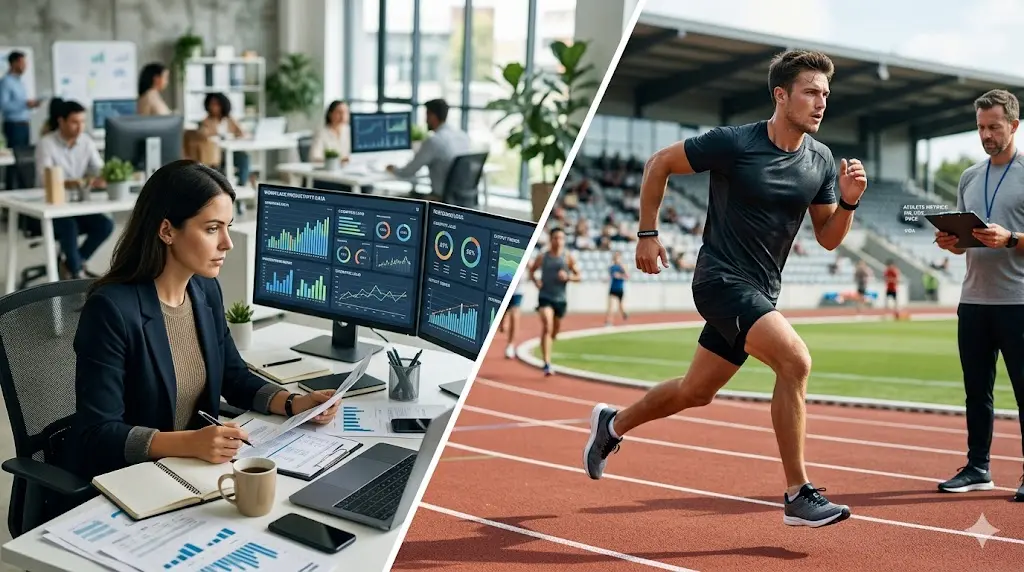
Workplace productivity and athlete performance have more in common than most people realize. Research increasingly shows that focus, recovery, mental resilience, nutrition, sleep quality, and environment affect both office workers and professional athletes in surprisingly similar ways.
Here’s the thing: companies and sports organizations are now borrowing strategies from each other because high performance no longer depends only on talent or long hours. It depends on sustainable systems, smarter recovery, and consistent mental clarity.
Research findings about workplace productivity and athlete performance show that physical health, mental recovery, sleep, technology, and structured routines directly improve long-term results. In 2026, businesses and sports teams are focusing more on energy management and performance optimization rather than simply increasing workload or training intensity.
What Is Workplace Productivity and Athlete Performance?
Workplace Productivity and Athlete Performance: The combined study of how physical health, mental focus, recovery, habits, and environment affect efficiency and long-term performance outcomes in professional settings and sports.
Most people separate workplace performance from athletic performance. Honestly, that’s outdated thinking now.
A corporate employee handling complex projects all day experiences cognitive fatigue similar to how athletes experience physical fatigue after intense training. Different environments, same biological limits.
In my experience, the companies getting better employee performance aren’t necessarily demanding more hours. They’re improving recovery systems, flexibility, and focus.
That mirrors elite sports almost perfectly.
Researchers studying productivity optimization have found that consistent routines, reduced distractions, and structured recovery periods improve both workplace efficiency and athletic output. The overlap is honestly bigger than many executives expected a decade ago.
Why Workplace Productivity and Athlete Performance Matters in 2026
The modern economy rewards sustained performance, not burnout.
That’s probably the biggest shift happening right now.
Businesses once praised employees for working nonstop. Sports organizations pushed athletes to train harder every year. Now research suggests overtraining and overworking often reduce results over time.
Mental Fatigue Is Becoming a Bigger Problem
Mental exhaustion affects decision-making, reaction time, creativity, and focus.
Athletes lose sharpness under fatigue. Employees make more mistakes, communicate poorly, and struggle with problem-solving when overloaded mentally.
One realistic example involved a mid-sized marketing agency that shortened internal meetings and introduced mandatory recovery breaks between deep-focus tasks. Productivity reportedly improved within months because employees maintained concentration longer during critical work sessions.
Simple adjustment. Big difference.
Sleep Quality Is Now Seen as Performance Infrastructure
What most people overlook is how deeply sleep affects both productivity and athletic recovery.
Poor sleep impacts reaction speed, memory retention, mood regulation, and physical recovery. Several performance studies have shown that even mild sleep deprivation reduces output dramatically.
A few years ago, talking about sleep optimization at work sounded almost lazy.
Not anymore.
High-performing companies now track burnout risks the same way sports teams monitor physical strain.
Technology Is Reshaping Human Performance
Wearable devices, AI-supported analytics, and biometric tracking are influencing both sports science and corporate productivity systems.
Athletes use recovery monitoring tools daily. Businesses increasingly use performance analytics to understand workflow patterns and reduce inefficiencies.
That doesn’t mean employees should feel constantly monitored, though. There’s a line there.
The smartest organizations use data to support people, not pressure them.
Recovery Is Finally Being Taken Seriously
Here’s a hot take some managers still dislike: recovery time is productive time.
Elite athletes understand this already. Muscles improve during recovery, not during constant strain.
Human cognition works similarly.
Employees who take structured breaks often return with stronger focus and better creativity compared to workers operating continuously for long periods.
That research is becoming harder to ignore.
How to Improve Workplace Productivity and Athlete Performance — Step by Step
Performance improvement usually works best when approached systematically rather than emotionally.
1. Prioritize Recovery Before Intensity
This sounds backward to some people, but recovery often determines performance capacity.
Sleep quality, hydration, stress reduction, and recovery windows should come first. Without them, performance eventually drops no matter how hard someone works or trains.
2. Build Structured Routines
Elite athletes follow routines because consistency reduces mental friction.
The same principle applies at work. Consistent schedules, focused work blocks, and clear priorities help maintain productivity without exhausting mental energy.
3. Reduce Distractions Aggressively
Research on productivity optimization repeatedly shows that constant interruptions destroy concentration.
One distracted hour can ruin an entire workflow cycle.
Notifications, unnecessary meetings, and multitasking probably damage performance more than many organizations realize.
4. Use Data Carefully
Performance analytics can identify burnout patterns, workload issues, and recovery gaps.
But there’s a balance.
Too much monitoring creates anxiety, which ironically reduces performance. Healthy performance systems support improvement without creating constant pressure.
5. Encourage Physical Movement
Even office workers benefit from movement-based performance strategies.
Short walks, mobility exercises, standing workstations, and stretching improve blood flow, posture, and mental clarity. Athletes obviously train differently, but the biological benefits of movement apply broadly.
Common Misconception About Productivity and Performance
One of the biggest myths is that more hours automatically create better results.
Research increasingly suggests the opposite in many cases.
After a certain point, exhaustion reduces performance quality significantly. Employees become slower. Athletes become injury-prone. Creativity drops. Decision-making weakens.
I learned this the hard way years ago while handling multiple projects without breaks. Output looked productive on paper, but actual work quality declined noticeably after several weeks.
Rest felt unproductive at first.
Turns out it wasn’t.
What Research Says About Stress and High Performance
Stress itself isn’t always harmful.
That surprises people sometimes.
Short-term pressure can improve alertness and motivation. Athletes often perform well under competitive stress. Employees can also produce excellent work under healthy deadlines.
The real issue is chronic stress without recovery.
That’s where burnout develops.
Researchers studying sports psychology and workplace wellness now emphasize recovery cycles almost as much as performance intensity itself.
Expert Tip
Teams that normalize recovery and mental wellness often outperform organizations that glorify nonstop hustle culture. Sustainable energy usually beats temporary overexertion over the long term.
Why Nutrition and Hydration Matter More Than People Think
Nutrition affects cognitive function almost immediately.
Athletes understand this because physical performance visibly drops after poor nutrition. Workplace performance changes too, though it’s sometimes less obvious.
Heavy processed meals can reduce focus. Dehydration affects reaction speed and concentration. Blood sugar instability impacts energy consistency.
One hypothetical example: imagine a software development team working through intense project deadlines while surviving mainly on caffeine and fast food. Productivity may spike temporarily, but mental fatigue and poor decision-making eventually appear.
Not exactly ideal for long-term performance.
The Connection Between Team Culture and Performance
High-performing teams usually share one important characteristic: psychological safety.
Athletes perform better when communication is clear and trust exists within teams. Employees behave similarly.
People work more effectively when they feel supported rather than constantly judged.
That doesn’t mean lowering standards.
It means creating environments where people can maintain high performance without operating in survival mode every day.
Big difference.
Expert Tips and What Actually Works
From what I’ve seen, sustainable performance systems share three common traits.
They value consistency over intensity.
They prioritize recovery before burnout appears.
And they treat mental health as performance infrastructure rather than a side conversation.
One executive I spoke with compared employee recovery to athletic conditioning. At first I thought it sounded exaggerated.
Honestly, he was probably right.
Companies ignoring human energy limits usually face declining performance eventually, even if short-term productivity initially looks impressive.
The Future of Productivity and Athletic Science
By 2030, performance optimization will probably become more personalized.
AI-supported health monitoring, individualized recovery systems, adaptive scheduling, and biometric analysis are already shaping sports science and workplace wellness programs.
Still, technology alone won’t solve performance problems.
Human energy has limits. Focus has limits. Recovery matters.
The organizations and teams that understand this earliest will likely outperform competitors over time.
Not because people work harder.
Because they work smarter and recover properly.
People Most Asked About Workplace Productivity and Athlete Performance
How are workplace productivity and athlete performance connected?
Both rely heavily on focus, recovery, sleep quality, stress management, and consistent routines. Research shows that mental and physical performance follow similar biological patterns.
Does sleep really affect productivity?
Yes. Sleep strongly affects concentration, memory, reaction speed, and emotional regulation. Poor sleep often reduces both workplace efficiency and athletic performance significantly.
Can exercise improve workplace productivity?
Absolutely. Regular physical movement improves energy, cognitive function, mood, and stress management. Even short activity breaks during workdays can help maintain mental clarity.
Why do companies study athlete performance models?
Sports science provides measurable insights about recovery, resilience, teamwork, and sustainable high performance. Many businesses now apply those lessons to employee wellness and productivity systems.
Is burnout becoming more common in modern workplaces?
In many industries, yes. Constant connectivity, digital overload, and long work hours contribute to higher burnout risks. Companies are increasingly focusing on mental wellness and recovery strategies to address this.
What role does nutrition play in performance?
Nutrition affects physical stamina, cognitive clarity, focus, and recovery. Stable hydration and balanced meals often improve both work efficiency and athletic endurance.
Can technology improve productivity safely?
Yes, when used responsibly. Performance analytics, wellness tracking, and workflow systems can support healthier productivity if they focus on improvement rather than excessive monitoring.
What’s the biggest mistake people make about productivity?
Many people assume longer hours equal better results. Research increasingly suggests that sustainable performance depends more on recovery, focus quality, and energy management than raw working time.
Businesses, agencies, startups, and SEO professionals looking to increase organic traffic and stronger brand visibility can benefit from business press release services combined with advanced link building services. These solutions support SEO ranking, instant publishing, media coverage, and high authority backlinks designed to help brands grow online credibility while reaching wider audiences through targeted digital promotion.